
Tractor Hydraulics: Understanding the System to Prevent Cold Start Failures
During winter, the hydraulic system is often the first to reveal its weaknesses. Inactive hitch at startup, stiff power steering, slow spool valves: these symptoms indicate a circuit struggling to build pressure in cold conditions. On John Deere, New Holland, Case IH, Massey Ferguson, Fendt, Deutz-Fahr, or Claas tractors, a quick diagnosis before winter often prevents downtime.
How Does a Tractor's Hydraulic System Work?
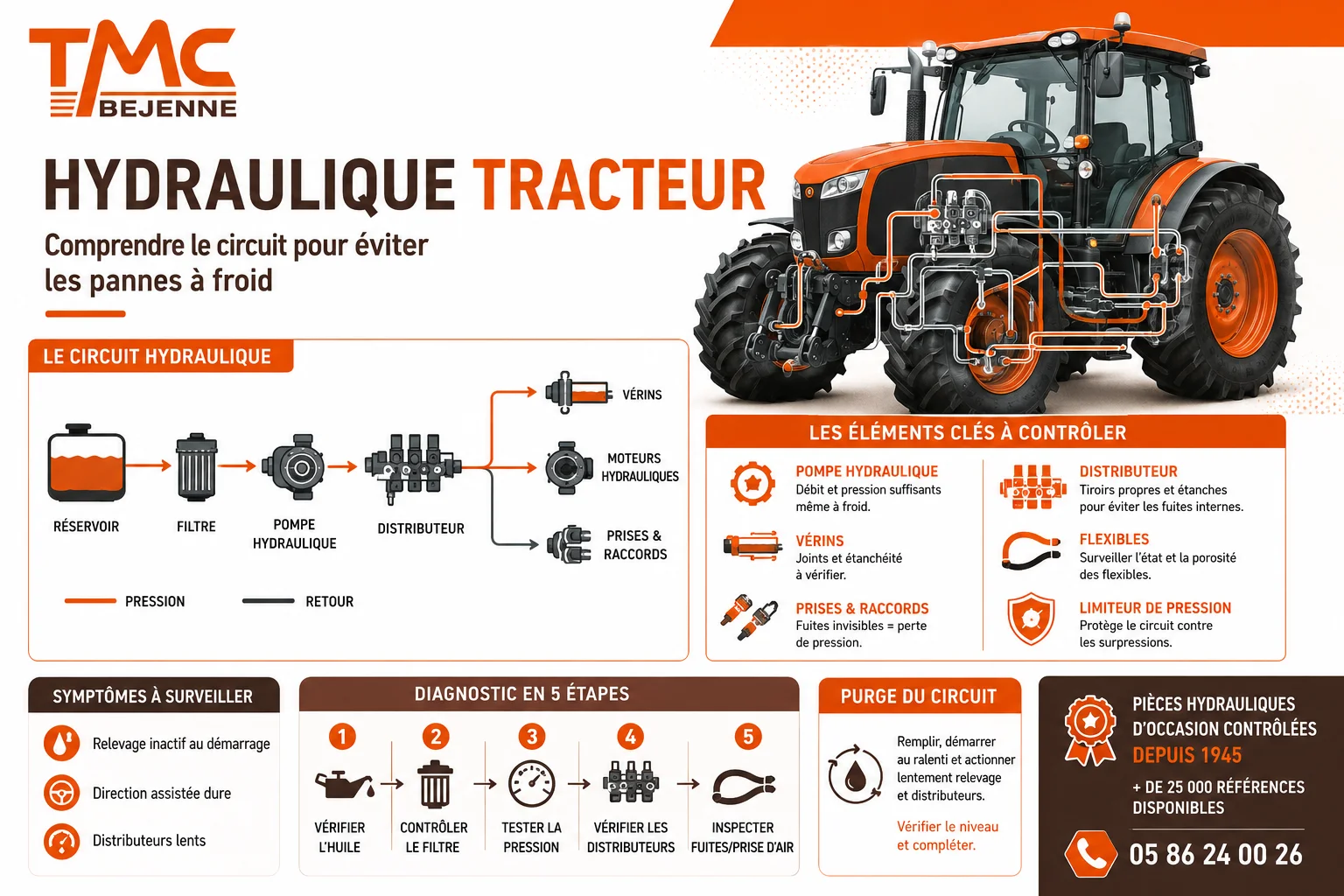
Agricultural hydraulics operate on a simple principle: a pump converts the engine's mechanical energy into fluid pressure. This pressurized fluid flows through a network of hydraulic hoses and spool valves to operate the hitch, power steering, or cylinders. The pump's flow consistency and oil viscosity directly affect the responsiveness of the entire system.
There are two main system types. Open-center circuits, common in older tractors, allow fluid to flow continuously back to the reservoir when no functions are engaged. Closed-center systems stop flow entirely when the implement demand is zero. In both types, cold weather worsens conditions: the oil thickens, flows less easily, forcing the pump to work harder.
Tractor Hydraulic Pump: The First component to Check
The hydraulic pump generates the flow needed for the fluid to reach the required pressure. Gear pumps are the most common on agricultural tractors; newer models use variable displacement pumps that adjust flow to match tool demand.
In cold conditions, a worn pump can no longer compensate for the increased oil viscosity. The flow drops, and pressure build-up becomes insufficient. On a Massey Ferguson or a Deutz-Fahr, this fault appears within minutes after startup, sometimes only under load. A cold cavitation noise—the pump "drawing a vacuum"—is often the first audible sign of advanced internal wear.
What Are the Components of a Tractor Hydraulic Circuit?
- Hydraulic Pump: the system's pressure source and the central piece for diagnosis.
- Tractor Hydraulic Spool Valve: directs fluid through sliding spools. Worn spools leak internally, reducing pressure under load.
- Cylinders: convert pressure into motion. Seals should be monitored, especially after a heavy season of use.
- Hydraulic Motors: convert pressure into rotational movement to drive components.
- Hydraulic Hoses and Connections: carry the fluid. Any porosity or leaks can cause pressure loss.
- Pressure Relief Valve and Safety Valve: protect the system from overpressure. A faulty relief valve may leak pressure even if the pump is functioning properly.
- Quick Couplers: quick connections for front and rear implements. Coupler compatibility (push-pull or ball type) should be checked with every tool change.
Tractor Hitch Problem: How to Interpret It
The front and rear hitches are the first systems affected by cold hydraulic failures. Two distinct scenarios should be considered.
A hitch that doesn't respond at startup but works after a few minutes of warming likely indicates oil that's too cold or a partially clogged filter. Conversely, a hitch that refuses to raise even when warm, or that lowers spontaneously, reflects a more established fault: worn pump, spool valve leaking internally, or poorly adjusted control valve. On a John Deere or Fendt, the rear hitch often shares the circuit with the power steering, so a pump problem typically affects both functions simultaneously.
Tractor Hydraulic Spool Valve and Connections: What to Check
- Hydraulic Spool Valve Connections: ensure each fitting is clean and sealed before winter. A dirty or loose connection can introduce air into the system.
- Double-acting Spool Valve Kit: if spools leak internally, replacement is often more cost-effective than repair.
- Loader Spool Valve: a heavily used component that should be prioritized for inspection. Check the smoothness of controls and spool sealing.
- Coupler Compatibility: push-pull and ball couplers are not interchangeable. An incompatible connection can cause immediate pressure loss without obvious pump issues.
Hydraulic Ports and Connections: The Hidden Leaks
Hydraulic ports and connections, especially quick couplers, are common but often overlooked leak points. In cold weather, seals harden and their effectiveness decreases. A fitting that showed no seepage in mild conditions may start leaking as soon as the temperature drops.
A quick visual check after a cold night is enough to spot fresh leaks: inspect hoses, fittings, and elbow joints under the tractor. A leak on the pump's suction side—between pump and reservoir—can cause cavitation and total flow loss, even if the pump itself is in good condition.

How to Bleed a Tractor Hydraulic Circuit?
Bleeding is necessary after replacing a component or hose, or if air has entered the system. It is done in a few simple steps.
Fill the reservoir with hydraulic oil of the viscosity recommended by the manufacturer, then start the engine at idle for a few minutes without engaging the system. Then slowly and repeatedly operate the hitch and spool valves to progressively purge the air. Check the oil level after the procedure and top up if needed. On some Case IH or New Holland models, a specific bleed point is provided on the filter or pump: refer to the manufacturer's documentation.
How to Diagnose a Hydraulic Failure on a Tractor?
The diagnosis follows a rigorous elimination process:
- Start with the oil: check level, appearance, and viscosity. Contaminated or degraded fluid is often the simplest cause to fix.
- Inspect the hydraulic filter: a clogged filter restricts flow before it even reaches the pump.
- Test pressure at the pump outlet: if insufficient, the pump is likely at fault.
- Check the spool valves under load: a leaking spool consumes pressure without the pump failing.
- Examine hoses and connections: an air intake on the suction side can cause cavitation.
For tractor hydraulic systems from Renault, Ford, Massey Ferguson, or John Deere, schematic diagrams are available in service manuals and remain a valuable aid for locating components before repair.
For any search of checked used hydraulic parts—pump, spool valve, cylinder—TMC Bejenne has supported operators since 1945, offering over 25,000 references. Call 05 86 24 00 26.
A pump converts the engine's mechanical energy into fluid pressure. This fluid flows through the circuit via hoses and spool valves to operate the hitch, power steering, or cylinders. The flow consistency and oil viscosity determine the system's responsiveness.
Start by checking the oil and filter, then test the pump outlet pressure. If the pressure is adequate but the hitch doesn't respond, focus on the spool valve or internal leaks. A cold cavitation noise usually indicates an intake difficulty rather than a dead pump.
Pump, reservoir, filter, spool valves, cylinders, hydraulic motors, hoses, fittings, and pressure relief valve. Any of these can cause performance loss. Cold acts as a revealer for already worn components.
After replacing a component or hose, start the engine at idle, then slowly and repeatedly operate the hitch and spool valves. Top up oil level after the procedure. For technical questions, TMC Bejenne can be reached at 05 86 24 00 26.
Need more information?
Do you need advice or have any questions? Our team is here to help! Don't hesitate to contact us for all the information you need. Call 05 86 24 00 26 to find out more!