
Agricultural tractor battery: essential tips to avoid startup failure after winter
The electrical system plays a crucial role in the operation of an agricultural tractor. It powers the starter, lighting, and electronic equipment found on modern agricultural tractors, from the dashboard to the onboard electrical circuit. On older tractors, the system is simpler but equally dependent on a well-maintained battery for starting.
Over time and with use, certain electrical components wear out or show signs of weakness. Before autumn work begins, checking this system—starting with the battery—allows detection of battery issues before they disrupt machine usage and helps avoid costly downtime at startup.
Why an agricultural tractor battery weakens after winter
An agricultural tractor battery is designed to operate regularly, not to remain inactive for long periods. Several factors accumulate during winter storage. A natural discharge occurs continuously, even without use, and severe cold significantly reduces the battery's efficiency and its ability to deliver current at engine start-up.
This is compounded by the lack of recharging due to the absence of a working alternator, oxidation of terminals, and internal sulfation, which progressively diminishes available energy. For New Holland or Case IH tractors, this combination of factors explains why a fully functional battery in autumn can be completely drained by spring, a common scenario.

Tractor starting troubleshooting: signs of a failing battery
- The starter turns slowly, indicating insufficient voltage
- The tractor fails to start despite several attempts
- The battery remains flat after a full recharge
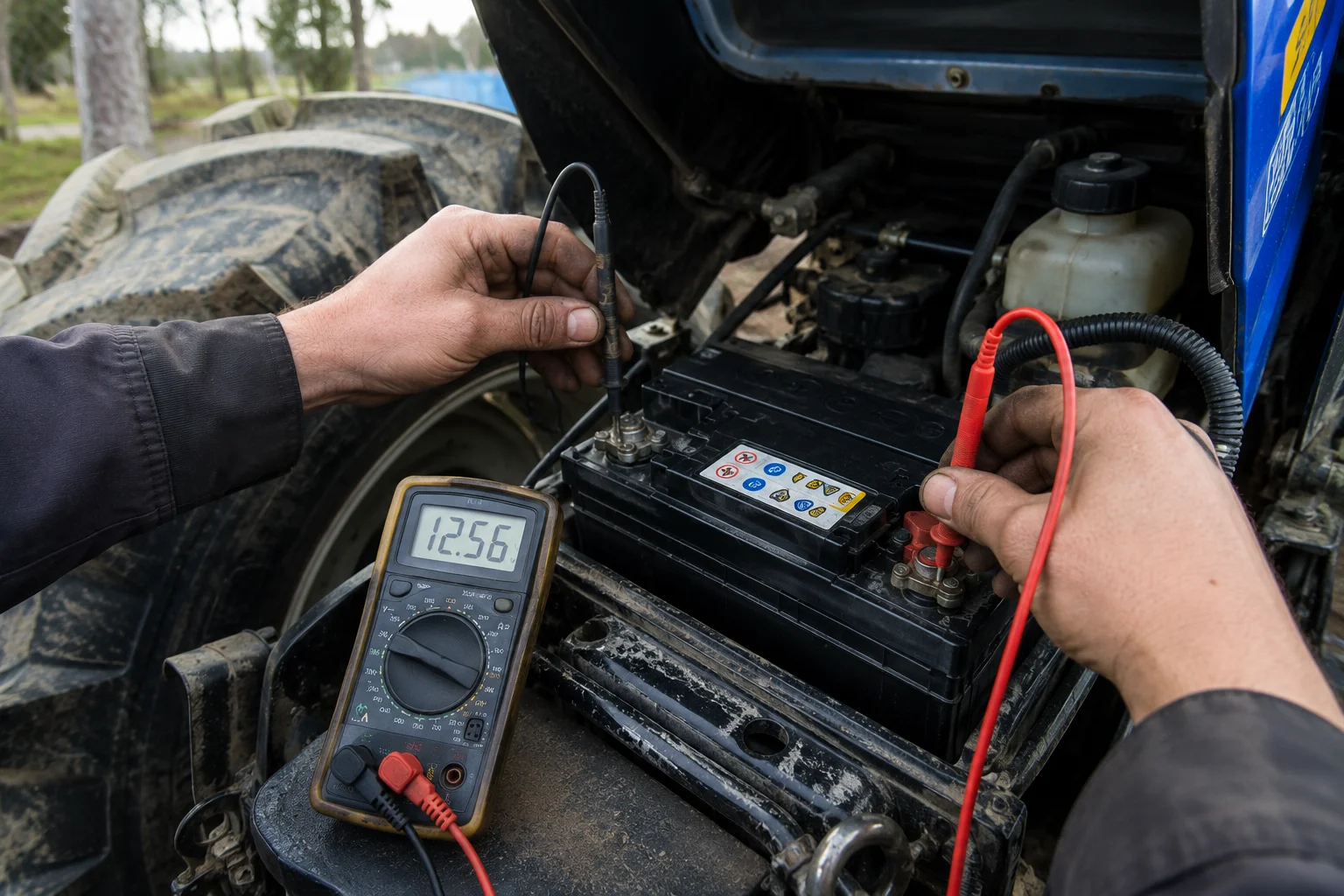
- Rapid loss of charge and unstable voltage on a multimeter
- The battery weight remains unchanged but real capacity is greatly reduced
- Growing difficulty starting the engine in cold weather
12V or 6V tractor battery: choosing the right amperage
Agricultural tractors usually operate on 12V, with older models still running on 6V. Capacity in ampere-hours (Ah) is selected based on engine power and onboard electronic equipment: a medium-power tractor often uses a 95Ah or 100Ah battery, while larger ones require 110Ah, 120Ah, 135Ah, or even 170Ah to 180Ah.
Choosing between open lead-acid batteries, AGM, and gel batteries depends on usage conditions, journey frequency, and vibration resistance. Modern agricultural tractors, heavily equipped with electronics, often require a higher-performance battery range to ensure reliable starting. Our sales team and experts assist you in selecting the essential criteria and finding a compatible tractor battery by agricultural brand before purchasing a new one.
Battery maintenance and charging: checks before winter storage
- Check battery voltage before storage
- Inspect battery cables and terminals: clean, tight, free from oxidation; cleaning with a brush is often sufficient
- Verify the charging system and alternator condition, often overlooked on Massey Ferguson or Fendt tractors
- Check electrolyte level on batteries that allow it
- Assess battery weight and overall condition; any swelling indicates weakness
- Test the battery with a multimeter to anticipate replacement
Best practices during winter
To minimize risks, a few simple measures are sufficient. It’s best to store the tractor in a dry place sheltered from cold and moisture, and to regularly monitor the battery.
Battery disconnect switch for tractors
Installing a battery disconnect switch prevents slow discharge caused by residual consumers in the electrical system. This simple solution completely cuts power during winter storage and protects the battery without additional handling.
Tractor battery charger and maintainer
A battery maintainer keeps an optimal charge without damaging the battery during long periods of inactivity. Unlike regular chargers, it automatically adjusts intensity and prevents overcharging.
Tractor battery booster: a troubleshooting solution
If starting difficulties persist despite precautions, a tractor battery booster provides temporary assistance. However, it does not replace a full diagnosis or, if needed, a deep charger for thorough recharging.
For John Deere or Deutz-Fahr tractors, these precautions significantly extend battery life and prevent the need for a new battery before work resumes. Regular checks during winter remain the best way to anticipate battery issues rather than facing them at startup.
Plan replacement before work resumes
- Starting difficulties noted before winter
- Need for more frequent battery recharges than before
- Unstable voltage or repeated deep discharges
- Battery tester indicates insufficient capacity
- Battery already aged beyond its usual lifespan
- Persistent weakness signs despite full recharge
Electrical parts available at TMC Bejenne
Since 1945, TMC Bejenne has offered used electrical parts recovered from dismantling: starters, alternators, and wiring harnesses for all major agricultural brands. Our 11-hectare yard allows us to quickly find the reference compatible with your tractor, regardless of brand or model age.
Each part is tested in our workshop before shipment, providing a reliable solution to get back up and running without waiting for a new part. Our teams guide you in selecting batteries or electrical components suited to your equipment, from recent models to old tractors.
The choice depends on voltage—commonly 12V, or 6V for older models—capacity in Ah suited to the engine power, and battery type (open lead-acid, AGM, or gel) based on usage conditions. Our technicians will guide you to the reference compatible with your tractor.
Amperage is determined by engine power and tractor's electronic equipment. Medium-power models typically work with 95Ah or 100Ah batteries, while the most powerful require 110Ah to 180Ah. Always check the manufacturer's specifications before ordering.
A slow-turning starter, a battery that remains flat after charging, or unstable voltage on a multimeter are signs of a battery nearing the end of its life. Beyond this point, recharging alone is insufficient.
Prices vary based on capacity, voltage, and tractor brand. Contact our teams at 05 86 24 00 26 for a quote tailored to your model.
Use a charger suited to the battery's voltage and capacity, preferably a maintainer for slow, regular charging. Disconnect the battery from the circuit before charging if it has been stored for a long time.