
Used Combine Harvester Grain Auger: Choosing the Compatible Part
Grain augers ensure the transfer of grain from the bottom of the combine harvester to the hopper. Grain auger, unloading auger, unloading tube: these components operate continuously throughout the harvest. On John Deere, Claas, New Holland, Case IH, or Massey Ferguson combines, a worn grain auger causes internal losses, blockages, or power drops. Ordering the part in October allows you to start the January harvest with a fully operational machine.
Role and Function of Grain Augers
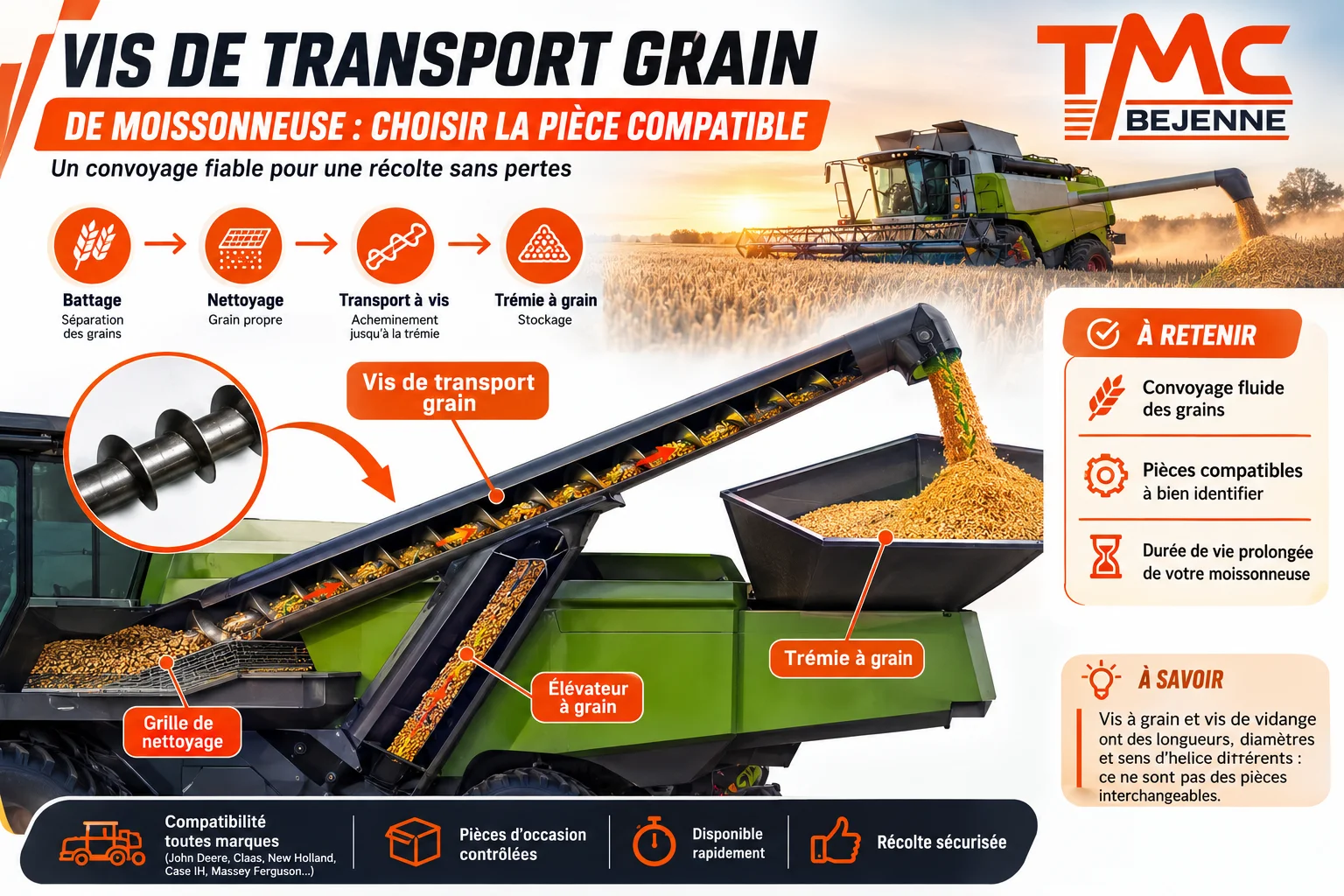
In these agricultural harvesting machines, the conveying mechanism relies on the helical design of the shaft: the continuous rotation of the spirals pushes the grain from one end of the casing to the other at a constant speed. This circuit engages downstream of the cutting bars and threshing system — once the grains are separated and cleaned — to transport them to the hopper.
The grain auger transfers the clean product from the cleaning sieve. The unloading auger conveys the threshing residue back to the beater for a second pass. These two components have distinct roles and are not interchangeable: they differ in length, diameter, and sometimes in the direction of the helix.
The power needed to drive these screw conveyors is taken directly from the machine’s transmission. A seized bearing or worn driveshaft disrupts rotation speed, causes repeated blockages, and reduces the circuit’s optimal performance. On Claas or John Deere combine harvesters, these grain augers operate under continuous stress and gradually wear, particularly at contact points inside the casing.
What Is a Grain Chain Conveyor?
Some combine harvesters, notably certain generations of New Holland or Massey Ferguson machines, use a grain chain conveyor to supplement or replace augers. The mechanism relies on paddles attached to a continuously moving chain in a closed casing — serving the same conveying function with a different design. The parts to monitor are not the spirals, but the paddles, shafts, and chain links.
Screw Auger and Conveyor Screw: Terms to Know
The grain conveyor screw is referred to by various names in catalogs and technical manuals: grain auger, grain screw, transfer auger, or conveyor screw. These terms describe the same helical design but may refer to components positioned differently in the machine:
- The bottom grain auger collects grain at the base of the cleaning system.
- The transverse conveyor screw moves the flow toward the grain elevator.
- Other screw conveyors handle grain transport to the top hopper.
Do not confuse these with flexible grain augers or hydraulic transfer augers, which are agricultural handling equipment designed for transferring grain over long distances — between storage bins or onto trailers. The internal combine harvester auger is a precision part subject to power and speed constraints not encountered by these external devices.
Grain Hopper: Final Stage of the Transport Circuit
The grain hopper is the integrated reservoir in the combine where clean grain is stored during the harvest. The grain transport circuit ends here: internal grain augers carry the flow from the cleaning sieve to the elevator, which unloads it into the top hopper.
The lower hopper—the bottom part of the reservoir—is fed first. The unloading auger transfers grain from the lower hopper onto a grain cart or into a trailer, which then transports it to the farm’s storage bins.
On large-capacity John Deere or Claas combines, the hopper can exceed 10,000 liters, with filling capacities reaching several tens of tons per hour under optimal conditions.
A fault in the grain transport circuit — worn grain auger, pierced unloading tube — results in an invisible loss of flow externally: the combine cuts normally, but the lower and upper hoppers fill slower than expected. Such internal losses are often detected late, during grain unloading onto the cart.
How to Tell if a Grain Auger Is Worn?
Under intensive use — several thousand hectares, abrasive grain types like corn — grain augers wear down gradually. Several signs help detect failure before it causes a breakdown during harvest:
- Flattened or missing spirals: visible during a visual inspection while stopped. A localized flattened area indicates advanced abrasive wear.
- Deformed central shaft: manual rotation test reveals imbalance. A auger with a warped shaft accelerates bearing wear.
- Reduced elevator output: decreased flow without adjustment changes points to an underperforming grain auger.
- Repeated blockages: without related adjustment issues indicate an auger near end of life.
- Unusual vibrations: a warped spiral or twisted shaft causes vibrations noticeable from the cab.
A cracked unloading tube produces the same symptoms as a worn auger: reduced flow to the hopper, with no grain visible on the ground. Side inspection hatches allow checking both components without full disassembly.
What is the Acceptable Grain Loss Tolerance for a Combine Harvester?
A well-adjusted combine harvester exhibits losses below 1% of treated flow. Beyond that, the loss is considered abnormal and requires investigation.
The type of grain harvested directly impacts these performance levels: on corn — a heavier and more abrasive grain than wheat or rapeseed — auger spirals wear two to three times faster at equivalent flow. Control intervals adjust accordingly depending on the predominant grain type on the farm.
Losses related to grain transport augers are called "internal losses": invisible externally but revealed during grain unloading onto the cart by hopper volume lower than expected yield. A worn unloading auger allowing grain to pass into the threshing return sends clean grain back to the beater, overloading the entire machine.
Are the Grain Auger and Unloading Auger Interchangeable?
No. These two components of the grain transport circuit differ in length, diameter, and sometimes the helix direction. Auger models are not interchangeable between positions, even on the same combine harvester.
Mixing them during assembly causes improper operation, potential casing damage, and overloads power transmitted to the shaft. It is crucial to know the exact reference before ordering — brand, model, and year of the machine.
Choosing and Installing a Used Grain Auger
Before confirming the purchase of a used grain auger, check the following:
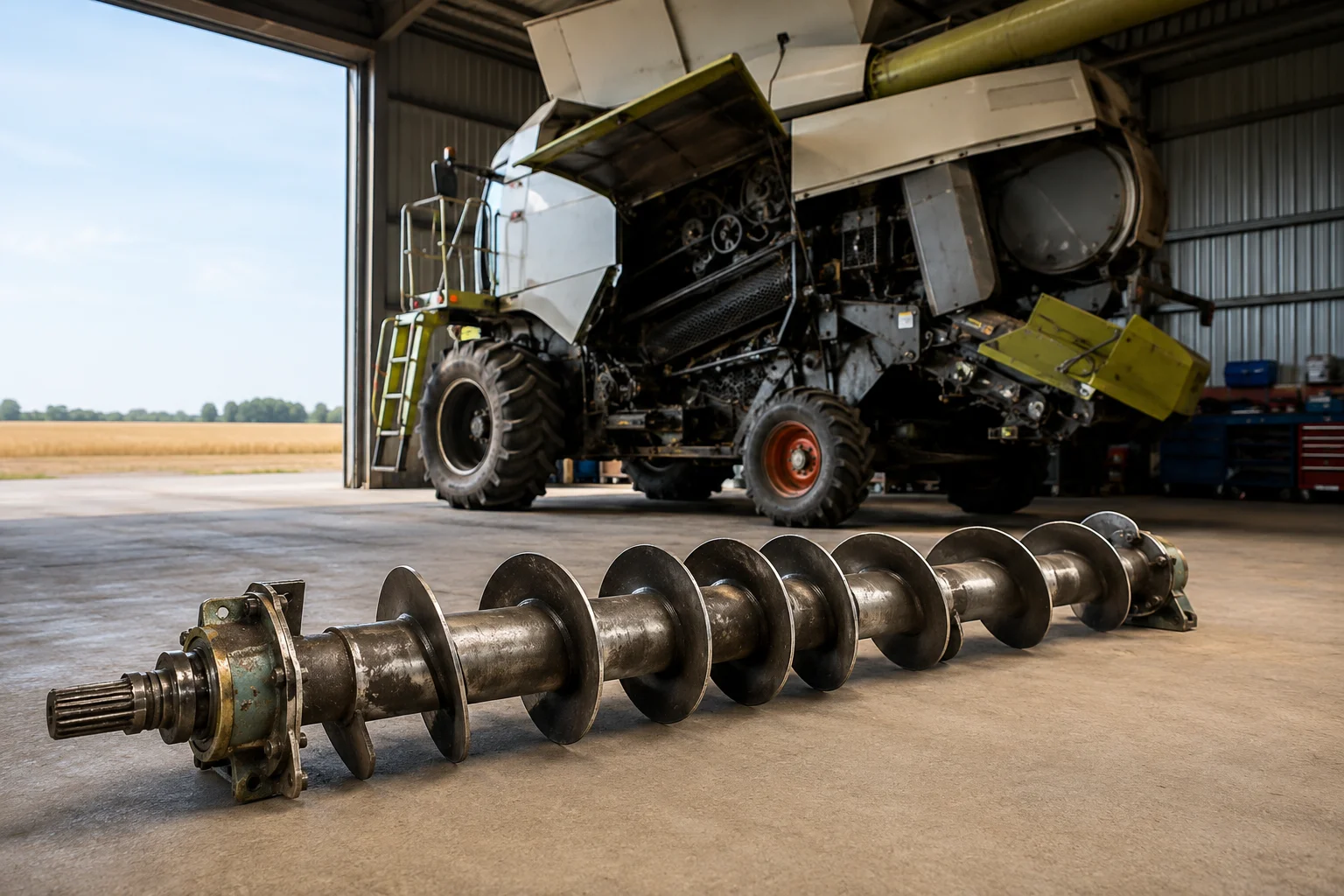
- Spirals: uniform along the entire length, without warping or material loss. The central shaft must be perfectly straight.
- Bearing mounts: clean, without wear grooves or abnormal play. Excessive play causes vibrations as soon as the auger runs.
- Auger diameter and length: must exactly match the original auger dimensions. A slightly larger diameter prevents fitting inside the casing.
- Coupling sleeve: inspect both ends. A cracked coupling sleeve compromises torque transmission and may cause breakdowns during harvest.
Each combine harvester requires specific auger models according to brand and generation: helical design, auger diameter, length, and helix pitch vary between models, as they do for cutting bars or feeding augers. Identifying the correct auger models before ordering avoids costly assembly errors.
Installation of a used auger follows two steps:
- Dry fit while stopped: manually rotate inside the casing to ensure the auger diameter does not rub against walls.
- Load test: detect power transmission faults or abnormal vibrations at normal working speed.
Auger installation always follows the same steps: fix the sleeves, verify alignment, and perform a no-load test before the first harvest.
Plan Ahead in October to Be Ready by January
January harvests — early rapeseed, forage crops — leave no time to wait for parts. As with cutting bars or feeding augers, a faulty grain auger disrupts feeding to storage bins and can force a stop mid-harvest.
Ordering in October — screw auger, grain auger, or conveyor screw depending on the model — allows receiving the part, checking its condition, and installing it before resuming work well-prepared.
For cereal farms, TMC Bejenne offers used grain augers sourced from combine harvester dismantling, inspected by our experts prior to shipping. We cover major brands on the market — John Deere, Claas, New Holland, Case IH, Massey Ferguson — with more than 25,000 references available since 1945. Tel. +33 5 35 54 42 10.
Reduced elevator performance without adjustment changes, unusual vibrations, or repeated blockages are the initial signs. A visual inspection while stopped can reveal flattened or missing spirals or a warped shaft.
No. These two components differ in length, diameter, and sometimes helix direction. Auger models are not interchangeable between positions. It is essential to know the exact reference before ordering.
Yes. For Case IH, New Holland, or Massey Ferguson combines from older generations, grain transport parts are often available at TMC Bejenne. Contact us at +33 5 35 54 42 10 with your machine’s brand and model.